
Context: European Encounters in the Americas

Chloe Davis
6 min read
Listen to this study note
Study Guide Overview
This study guide covers Period 1: Pre-Columbian America and Early Encounters (1491-1607) in AP US History. It focuses on contextualization, pre-Columbian societies (including Cahokia), the impact of European arrival (disease, enslavement, cultural clashes), and the resulting transformations. Key terms include the Bering Land Bridge and the Columbian Exchange. The guide also provides practice questions and exam tips.
#AP US History: The Night Before Review
Hey! Let's get you prepped and confident for tomorrow's APUSH exam. We're going to make sure you're not just memorizing facts, but truly understanding the big picture. Let's do this!
#🧭 Contextualization: Setting the Stage
Contextualization is all about understanding why things happened. It's not just about knowing what happened, but also the environment, events, and ideas that shaped it. Think of it as the 'backstory' to every event we study.
#Why 1491-1607?
- 1491: Before Columbus. Acknowledges the complex societies already thriving in the Americas.
- 1607: Jamestown. Marks the first successful permanent English colony in North America.
This period is foundational! Understanding the interactions between Native Americans, Europeans, and Africans sets the stage for the rest of US History. It's a critical area for both multiple-choice and essay questions.
#🌍 Period 1: Pre-Columbian America and Early Encounters (1491-1607)
#🌉 The Bering Land Bridge
- How: Nomadic Asian hunters crossed the Bering Land Bridge (present-day Bering Sea) around 20,000 years ago, following big game.
- Impact: These hunters populated North and South America, developing diverse cultures and societies.
#🏞️ Native American Societies
- Diversity: Tribes adapted to their environments, leading to diverse agricultural techniques and social structures.
- Cahokia: A major Mississippian settlement near present-day St. Louis. It was larger than many European cities at the time, with a population of 20,000 people.
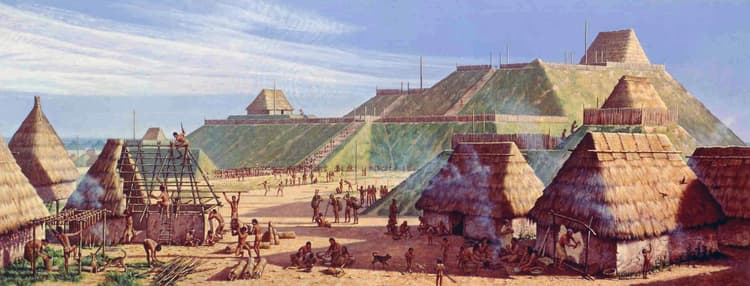
Cahokia, as it may have appeared around 1150 CE. Painting by Michael Hampshire for the Cahokia Mounds State Historic Site.
Cahokia shows that Native American societies were complex and advanced, challenging the idea of a 'primitive' New World.
#💥 The Clash of Cultures
- European Arrival: Columbus's arrival marked the beginning of significant changes in the Americas.
- Disease: European diseases decimated Native American populations, who had no immunity.
- Labor: The decline in Native populations led to the enslavement of Africans, starting in 1501. Over 11.2 million Africans were forcibly brought to the Americas.
- Divergent Worldviews: Interactions between Native Americans, Europeans, and Africans led to conflicts over religion, gender roles, family, land use, and power.
Remember D.I.E. for the major impacts of European arrival:
- Disease
- Interaction (and conflict)
- Enslavement
#🔄 Transformation and Adaptation
- New Society: The mixing of Native American, European, and African cultures created a new, complex society in the Americas.
- Power Shifts: These interactions led to power struggles and changes in social structures.
When you see a question about early America, think about the interactions between these three groups. How did each influence the other? This is a key theme!
Practice Question
#Multiple Choice Questions
-
Which of the following best describes the primary reason for the drastic decline in the Native American population after the arrival of Europeans? (A) Warfare with European settlers (B) Enslavement and forced labor (C) Introduction of new diseases (D) Displacement from their ancestral lands
-
The settlement of Cahokia is significant because it demonstrates which of the following about pre-Columbian North America? (A) The widespread use of advanced metalworking techniques (B) The existence of complex, organized societies (C) The lack of agricultural development (D) The absence of any form of social hierarchy
#Short Answer Question
Briefly explain ONE major difference between Native American and European views on land ownership in the period 1491-1607. #### Free Response Question
Explain how the interactions between Native Americans, Europeans, and Africans in the period 1491-1607 led to significant social and cultural changes in the Americas. In your response, be sure to address the impact on at least TWO of these groups.
FRQ Scoring Breakdown:
- Thesis (1 point): A clear, historically defensible thesis that addresses the prompt.
- Contextualization (1 point): Describes a broader historical context relevant to the prompt.
- Evidence (2 points): Provides specific examples to support the thesis and analysis.
- Analysis (2 points): Explains the connections between the evidence and the thesis, demonstrating an understanding of the interactions and their consequences.
- Complexity (1 point): Demonstrates a nuanced understanding of the topic by considering multiple perspectives or contradictory evidence.
#🎯 Final Exam Focus
#Top Topics to Review:
- Native American Societies: Their diversity, complexity, and pre-Columbian achievements.
- The Columbian Exchange: The exchange of plants, animals, and diseases between the Old and New Worlds.
- Early Colonial Encounters: The impact of European colonization on Native Americans and Africans.
#Common Question Types:
- Multiple Choice: Focus on specific events, people, and their significance.
- Short Answer: Requires concise explanations of key concepts and comparisons.
- Free Response: Demands in-depth analysis, synthesis, and the ability to connect events to broader historical themes.
#Last-Minute Tips:
- Time Management: Don't spend too long on any one question. If you're stuck, move on and come back later.
- Read Carefully: Pay close attention to the question's wording. What is it really asking?
- Connect the Dots: Think about how events in this period relate to later periods. APUSH is all about making connections!
- Stay Calm: You've got this! Take deep breaths and trust your preparation.
Good luck! You're going to do great!
Continue your learning journey



How are we doing?
Give us your feedback and let us know how we can improve