
European Exploration in the Americas

Grace Lewis
7 min read
Study Guide Overview
This study guide covers the Age of Exploration, starting with Columbus's 1492 voyage and its significance. It explores European motivations (God, Glory, and Gold) and key explorers' achievements. The guide highlights important technologies like the caravel and provides practice questions covering multiple-choice, short answer, and free-response formats. It emphasizes the impact on native populations and the Columbian Exchange's importance for the exam.
#🚀 AP US History Study Guide: Age of Exploration 🚀
Hey there, future AP historian! Let's make sure you're prepped and ready to ace this exam. We're going to break down the Age of Exploration, making it super clear and easy to remember. Let's dive in!
#🧭 The Spark: Columbus's Voyage (1492)
Columbus's voyage is a major turning point. It marks the beginning of sustained European contact with the Americas, leading to massive global changes.
-
New Tech: The caravel 🚢 was a game-changer. These ships were smaller, faster, and more maneuverable than previous vessels. They had:
- Narrow hulls for shallow waters
- Triangular lateen sails for sailing against the wind
-
The Voyage:
- Funded by the Spanish crown 👑, Columbus set sail in August 1492 with three caravels: La Niña, La Pinta, and Santa María.
- Landed in the Bahamas on October 12, 1492, encountering the Taino people.
- Columbus renamed the island San Salvador and claimed it for Spain.
-
Columbus's Perspective:
- His journal shows a mix of curiosity and a desire to exploit the Taino people.
- He noted their willingness to trade and their lack of weapons, seeing them as potential servants.
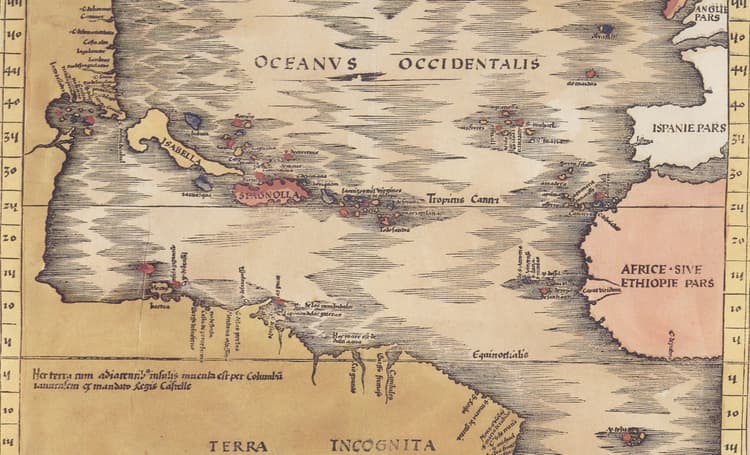
1513 Atlantic map from cartographer Martin Waldseemuller. Wikimedia.
Remember Columbus's voyage as the starting gun for European exploration of the Americas. It's the catalyst for everything that follows.
#🌍 The Age of Exploration: Beyond Columbus
-
Motivations: European powers were driven by the 3 Gs: God, Glory, and Gold ⛪🌟💸
- God: Spreading Christianity.
- Glory: National pride and personal fame.
- Gold: Wealth and resources.
-
The Race Is On: After Columbus, other European powers rushed to explore and claim land in the New World.
#🧭 Key Explorers
Here's a breakdown of some of the most important explorers:
| Date | Explorer | Country | Major Achievement |
|---|---|---|---|
| 1000 CE | Leif Ericson | Norway | First to land in New England area. |
| 1487 | Bartolomeu Dias | Portugal | First to sail around the southern tip of Africa, opening a sea route to Asia. |
| 1492 | Christopher Columbus | Spain | Landed in the Bahamas, leading to the European discovery of the Americas. |
| 1497 | John Cabot | England | Explored the Chesapeake Bay, laying the groundwork for British claims in Canada. |
| 1499 | Amerigo Vespucci | Spain | Explored the coast of South America; America is named after him. |
| 1513 | Juan Ponce de Leon | Spain | Discovered Florida while searching for the fountain of youth. |
| 1519 | Ferdinand Magellan | Spain | Reached the southern part of South America while attempting to circumnavigate the globe. |
| 1519 | Hernan Cortez | Spain | Conquered the Aztecs in Mexico. |
| 1531 | Francisco Pizarro | Spain | Conquered the Incas in Peru. |
| 1534 | Jacques Cartier | France | Explored parts of Canada while searching for the Northwest Passage. |
| 1540 | Francisco Coronado | Spain | Led an expedition from Mexico to present-day Kansas, exploring the southwestern U.S. |
| 1603 | Samuel de Champlain | France | Explored and established Quebec in New France. |
| 1607-08 | Henry Hudson | England | Discovered the Hudson River and Hudson Bay. |
Use the mnemonic "Every Brilliant Captain Just Makes People Happy" to remember some of the key explorers: Ericson, Bartolomeu, Cabot, Juan, Magellan, Pizarro, Hudson. This helps you recall a few of the big names quickly.
Pay attention to the country each explorer sailed for. This is a common point of confusion in multiple-choice questions. Also, note the impact of their voyages – did they find a new route, claim new land, or conquer an empire?
#🎯 Final Exam Focus
-
High-Priority Topics:
- The impact of the Columbian Exchange (not covered in these notes but super important!)
- Motivations for exploration (God, Glory, Gold).
- The consequences of European contact on Native American populations.
- Key explorers and their achievements.
-
Common Question Types:
- Multiple Choice: Expect questions about the specific goals of explorers, the impact of new technologies (like the caravel), and the consequences of exploration.
- Short Answer: Be prepared to discuss the motivations behind exploration and the different approaches of various European powers.
- Free Response: FRQs often ask you to analyze the impact of exploration on both Europe and the Americas, including the Columbian Exchange.
-
Last-Minute Tips:
- Time Management: Don't spend too long on any single question. Move on and come back if you have time.
- Common Pitfalls: Be careful not to confuse explorers from different countries. Double-check your answers, especially on multiple choice.
- Strategies: For FRQs, start with a strong thesis statement and use specific evidence to support your points. Think about the long-term consequences of the Age of Exploration.
#✍️ Practice Questions
Practice Question
Multiple Choice Questions
-
Which of the following best describes the primary motivation for European exploration during the 15th and 16th centuries? (A) The desire to establish democratic governments in the New World (B) The pursuit of religious freedom and refuge from persecution (C) The quest for economic gain, national glory, and the spread of Christianity (D) The establishment of trade routes to Asia via the Pacific Ocean
-
The caravel was significant in the Age of Exploration because it: (A) Was the first ship to circumnavigate the globe. (B) Allowed for safer travel across the Atlantic Ocean. (C) Was faster and more maneuverable, enabling longer voyages. (D) Was the primary vessel used for transporting enslaved Africans.
Short Answer Question
- Briefly explain TWO motivations for European exploration of the Americas during the 15th and 16th centuries. Provide ONE piece of specific evidence to support each motivation.
Free Response Question
Analyze the social, political, and economic effects of the Age of Exploration on both Europe and the Americas from 1492 to 1700. In your response, consider the impact on indigenous populations, the development of trade networks, and the rise of European powers.
Scoring Breakdown for FRQ
- Thesis (1 point): Presents a clear, historically defensible thesis that addresses the prompt.
- Evidence (4 points): Provides specific examples of social, political, and economic effects on both Europe and the Americas. (e.g., Columbian Exchange, encomienda system, rise of mercantilism).
- Analysis (2 points): Explains how the evidence supports the thesis and demonstrates understanding of the complexities of the Age of Exploration. (e.g., analyzing the impact of disease on Native populations or the shift in global power dynamics).
- Synthesis (1 point): Extends the argument by connecting it to a different time period or theme (e.g., comparing the Age of Exploration to later periods of colonization or globalization).
Alright, you've got this! Review these notes, take a deep breath, and go crush that AP exam! You're a history rockstar! 🌟
Continue your learning journey







How are we doing?
Give us your feedback and let us know how we can improve